
The Digital Control of Psychology Today and the World of Algorithms
In the current mental health care system, online services are now the main way to connect patients with care. In this digital world, Psychology Today is more than just a directory. It’s a dominant force that controls the search engine results pages (SERPs) and decides how private practices in North America are seen by the public. The platform appears as the top Google search result for people seeking therapy 96.2% of the time. This makes it an unavoidable resource for clinicians looking to grow their practice. For today’s therapists, understanding how this platform works is no longer just a bonus marketing skill; it’s essential for survival.
The main question that drove this report, “How can you game the Psychology Today algorithm?” shows that many people are frustrated with the system. They think it is unclear, unpredictable, and often unfair. This perception is not unfounded. The platform’s sorting mechanisms often make it so that a profile can be on the first page of results one day and then completely disappear from the twentieth page the next, even if the therapist’s credentials or profile content haven’t changed. To deal with this ever-changing environment, you have to go beyond the simple idea of “ranking” and understand the complicated relationship between random rotation, Boolean filtering, and psycholinguistic conversion. These things actually power the platform’s lead generation engine.
1.1 The Stochastic Rotation Model vs. Meritocratic Ranking
Many people think that Psychology Today uses a similar ranking algorithm to Google’s organic search, but this is not true. In Google’s ecosystem, ranking depends on authority, relevance, the number of backlinks, and content quality, Optimization leads to long-term visibility. Psychology Today uses a different system for its main directory listings. It uses a random system that changes regularly.
The reason for this design choice is based on the platform’s business model. Psychology Today is a subscription service. To keep their paying members, they need to provide value. If the algorithm were purely meritocratic, it would consistently rank the “best” profiles with the most clicks or the longest tenure at the top. However, new subscribers and those in saturated markets would never achieve visibility. This would lead to mass cancellations. The system is designed to make information accessible to everyone. For a general search like “therapist in Chicago, IL,” the algorithm changes the order of profiles that meet the location criteria. This makes sure that every subscriber has an equal chance of appearing in the top spots when enough searches are made.
But this also means there’s a lot of variation for each individual user. A therapist might buy a lottery ticket for visibility, even if they can’t be sure they’ll get a guaranteed spot. This randomness explains why it’s technically impossible to “game” the system in the traditional SEO sense. That is, it’s impossible to optimize code to force a permanent number one ranking. The algorithm actively resists static hierarchies to maintain the illusion of opportunity for its entire customer base. Therefore, the goal for the therapist should change from trying to control the rank (which is random) to maximizing the surface area (the number of lotteries entered) and the conversion efficiency (the likelihood of a click when visibility occurs).
1.2 The “Best Match” Logic and Relevance Weighting
By default, broad searches are sorted randomly. However, the system behaves differently when users engage with specific search modifiers or the “Best Match” sorting option. This makes the algorithm more complex, and it can be affected by changes made to improve the profile.
The “Best Match” sort order, which is different from the default sort, uses a relevance algorithm. This algorithm looks at the text and metadata of a profile and compares it to the specific search terms used by a potential client. A “Best Match” system is similar to other bibliographic and directory algorithms, such as those used in PubMed. It calculates a weight for each profile based on how often a term appears and where it is placed in the field. For example, if a user searches for “Cognitive Behavioral Therapy for Insomnia,” a profile that clearly mentions “CBT-I” and “Sleep Disorders” in its specialized fields and bio text will receive a higher relevance score than a general profile that merely lists “Sleep Issues” among many other conditions.
Machine learning components analyze user interaction signals to improve relevance weighting. If profiles with certain keywords get a lot of clicks or contacts for specific searches, the algorithm “learns” to show similar profiles to future users with the same search intent. This change from random rotation to weighted relevance is the exact moment when profile optimization becomes effective. By organizing the profile’s information in a way that matches the high-intent keywords used by the target audience, a therapist can move from the general pool of information to the prioritized “relevance” pool.
1.3 The Basics of Boolean Filtering
Before any sorting, random or weighted, takes place, the Psychology Today engine applies a rigorous set of filters. This is the “Exclusion Phase” of the search process. In this phase, most therapists unknowingly make it harder for others to find them.
The directory works like a subtractive database. When a user goes to the main page, they see a lot of providers. When they apply filters like “United Healthcare,” “Female,” “Teenagers,” and “EMDR,” the system excludes any profile that doesn’t have all of those tags. This means that if a tag is missing, it’s not just a small mistake; it means that the tag can never be used in that search market.
Table 1: Impact of Filter Stacking on Profile Visibility
| Search Complexity | User Filters Applied | Algorithmic Impact | Strategic Implication |
| Broad Search | Location Only (e.g., “Brooklyn, NY”) | Stochastic Rotation: Profile competes with 1,000+ others. Visibility is low and random. | Dependence on luck. High competition. Low conversion probability. |
| Moderate Search | Location + Insurance (e.g., “Brooklyn” + “Aetna”) | Binary Exclusion: 40-60% of profiles removed. Remaining pool is rotated. | Essential to list all accepted payers accurately to survive this cut. |
| Specific Search | Location + Insurance + Issue (e.g., “Brooklyn” + “Aetna” + “OCD”) | Relevance Weighting: Pool shrinks to <50. Algorithm may prioritize “Specialists” over “Generalists.” | Niche specialization becomes a visibility asset. High conversion probability. |
| Hyper-Specific | Location + Insurance + Issue + Modality (e.g., “… + ERP”) | “Best Match” Dominance: Pool shrinks to <5. User reads every profile. | The “Jack of All Trades” penalty applies; true specialists win the click. |
The data shows that as users add filters, the results become less random and more relevant. So, the “game” is to make sure the profile is designed to stand out to the right clients, instead of trying to appeal to everyone.

1.4 The “Freshness” Variable: The cycle of activity and rest
Some therapists believe that frequent interaction with the profile, such as logging in daily, changing a zip code, or editing a bio sentence, can improve its ranking. This belief is based on the idea that the algorithm prioritizes active users to ensure that directory results do not lead to inactive or unresponsive practices.
Psychology Today doesn’t officially confirm a “login bump,” but the way large-scale directory databases are set up makes it likely that this theory is true. Search engines often use a “Last Modified” timestamp to decide which results to show or to adjust the order of the results. If a profile hasn’t been accessed in six months, it might be flagged as “stale.” This lowers the probability of it being shown in the main cycle of results. This is done to protect the user experience and make sure there are no “dead ends.”
But the effect probably isn’t as big as people say. It is unlikely that having to log in every day will make it easier to see what is going on. Instead, the relationship is probably simple or has different levels. “Active” vs. “Dormant.” A strategic approach doesn’t require daily management, but rather regular updates, like logging in weekly or biweekly to add a small piece of information. This keeps the profile categorized as active within the database’s operational parameters.
Geographic Arbitrage and the Zip Code Strategy
If the algorithm is a lottery, then the “Target Your Listing” feature is how a therapist buys multiple tickets. Psychology Today lets you target more than one place. You can enter up to four different zip codes or cities. This feature is the most powerful tool for expanding the “probabilistic surface area” of a practice.
2.1 The Math of Location Targeting
By default, the algorithm links a profile to the address where it’s registered. When a user searches for “therapist in 90210,” the system shows profiles of therapists that are physically located in that zone. But telehealth has made it so that being effective in medicine doesn’t depend on being physically close to a patient. This has created an opportunity to make money. A therapist working from a home office in a rural suburb can effectively treat clients in a major metropolitan hub, provided they can appear in those search results.
The “Target Your Listing” feature lets the therapist manually add their profile to the groups of zip codes where they don’t actually work. This is not just a convenience; it increases market access. If a therapist only lists their home zip code, they are competing in one pool. By using all four available slots, they increase their exposure four times.
2.2 Strategic Zip Code Selection: The Portfolio Approach
The selection of these target zip codes should not be random. To do this, it’s important to have a portfolio that includes both high-volume, competitive markets and high-value niche markets. A therapist must act as a demographic investor, placing their “visibility bets” where the return on investment (ROI) is highest.
- Strategy A: The Affluence Target
- Mechanism: For therapists who don’t accept insurance, the “Insurance” filter is the biggest obstacle. To get around this, the therapist has to focus on places where more people are likely to pay for their own medical care. This means finding zip codes where people have a lot of money and expensive things. A therapist in a middle-income area should use their target slots to list the wealthiest areas of their state (for example, a therapist in New Jersey should target Short Hills or Alpine).
- Outcome: The profile appears before users who don’t mind spending more, which makes up for the lack of insurance compatibility.
- Strategy B: The University Anchor
- Mechanism: Universities are unique environments with high rates of students dealing with mental health challenges like “Adjustment Disorder,” “Anxiety,” and “Identity” issues. The student population is always changing, these students grew up with technology, and the on-campus counseling centers often don’t have enough resources to help them. If you target specific zip codes of major universities (for example, 02138 for Harvard Square), you can reach a lot of people who are comfortable with telehealth.
- Outcome: High volume of inquiries, though potentially lower fee-per-session depending on the student’s financial status.
- Strategy C: The Saturation Gap
- Mechanism: In big cities, there are often a lot of therapists for every resident, which can make the rotation less effective. On the other hand, “therapy deserts” are often rapidly growing suburbs or mid-sized industrial towns that have high demand but few local providers. The goal is to focus on a specific zip code where there are a lot of people but not many healthcare providers.
- Outcome: The profile faces less competition in the rotation, appearing on the first page more frequently and staying there longer.
- Strategy D: The Commuter Corridor
- Mechanism: Many clients prefer to see a therapist near their workplace rather than their home to facilitate appointments during the workday (lunch hours or immediately post-work). Targeting the Central Business District (CBD) zip codes.
- Outcome: Captures the professional demographic, which often correlates with better insurance plans and higher reliability.

Table 2: Comparative Analysis of Geographic Strategies
| Strategy | Ideal For | Pros | Cons |
| Affluence Target | Private Pay / OON | High fee tolerance; less insurance friction. | High competition; demanding clientele. |
| University Anchor | New Practices / Interns | High volume of leads; rapid caseload building. | Lower fees; scheduling around semesters. |
| Saturation Gap | Telehealth Practices | High visibility frequency; less competition. | Potentially lower insurance reimbursement rates. |
| Commuter Corridor | Anxiety/Stress Specialists | Professional clientele; reliable attendance. | Competition from in-person CBD practices. |
2.3 The “Nomad” Rotation Tactic
For telehealth practices that are fully digital, the idea of a “local” market is no longer relevant. A licensed mental health professional in California can treat a patient in Eureka just as easily as one in San Diego. This allows the “Nomad” tactic, which is a methodical change of target zip codes over time to test how the market responds.
A therapist might target the San Francisco Bay Area for the first three months of the year, look at the data about how many people click on the link and buy the product, and then change the target to Los Angeles or Sacramento for the next three months. This testing approach lets the business figure out which markets are best for them. They can then make a permanent decision to focus on the markets that perform best.
The Psychology of the Click: How to Increase Conversions
Once the technical problems are solved and the profile appears on the user’s screen, the challenge changes from technical visibility to psychological persuasion. The user sees a list of twenty similar products (therapists). People make decisions about which profile to click on by using a process called “thin-slicing.” This is a way of making quick decisions without thinking too much.
3.1 The Visual Hierarchy: Face Perception and Trust
The profile picture is the most important part of the Click-Through Rate (CTR) equation. The study of how humans have evolved focuses on how we recognize faces. The brain processes the emotional meaning of a face very quickly, even before we read the text that goes with it.
The “Warmth vs. Competence” Trade-off
Studies show that when people are looking for a helper (like a therapist or doctor), they unconsciously look for two main qualities: Warmth (Can I trust you?) and Competence (Can you help me?).
- The Error: Many therapists upload formal photos of themselves. These photos often show them looking stern and serious. They are usually in black and white or against a library backdrop. This shows that they are competent, but they often don’t have the right attitude. A “cold” face can make a distressed client feel unsafe.
- The Optimization: The best headshots show a “Duchenne smile,” which is a real smile that makes the muscles around the eyes look good. It should use soft, natural lighting. People who do very well often use outdoor backgrounds or “environmental” portraits (like sitting in a comfortable chair) instead of plain studio backdrops. This makes it easier for people to access the care they need and reduces the fear that often comes with going to the doctor.
3.2 The “Three-Line Hook” and the Fold
On the search results page, the user only sees the therapist’s photo, name, and the first 200 to 270 characters of their biography. This shortening creates a “fold.” If the content above the fold isn’t interesting, the user won’t look at the rest of the profile.
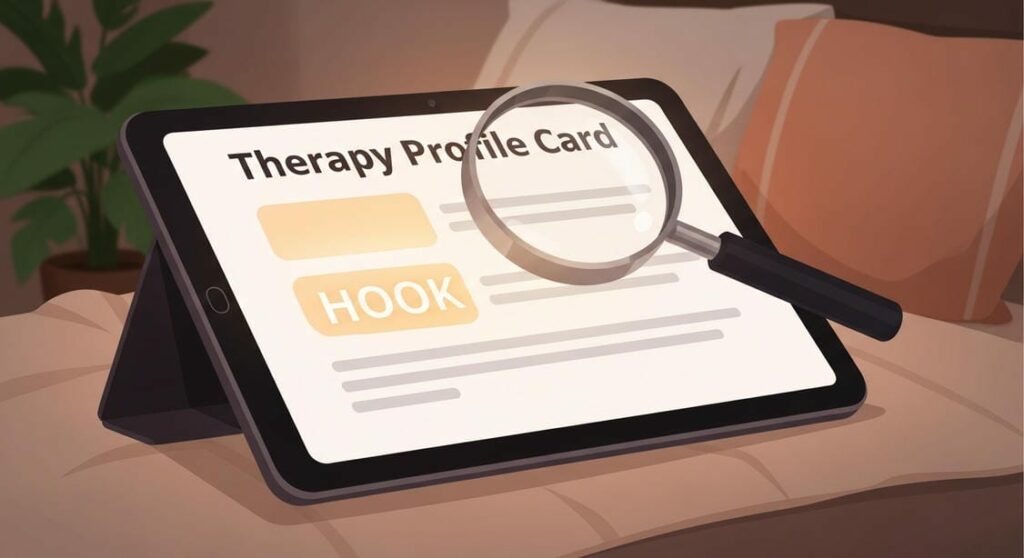
The Standard Failure Mode:
“I am a Licensed Clinical Social Worker with over 15 years of experience. I graduated from Columbia University, and I specialize in…”
This approach doesn’t work because it’s too focused on the provider. It makes the user have to check the therapist’s credentials before the therapist has said that the user’s pain is real. In a list of 20 profiles, the user is looking for someone who will understand them, not someone who has a lot of experience.
The Optimized “Client-Centric” Hook:
“Do you wake up every morning feeling worried and scared about the day ahead? You have achieved so much, yet you feel like a fake. I can help you…”
This approach works because it connects with people right away. It explains the symptoms better than the client could, which makes the client trust the doctor right away. The user clicks “View More” because they feel understood, not just informed.
3.3 The Video Advantage: The Para-Social Bridge
Psychology Today strongly encourages the use of introductory videos. Profiles with videos are often highlighted in search results with a special icon or button. This makes the profile stand out and attract attention.
Beyond the visual prominence, the video serves as a “Para-Social Bridge.” Therapy is a close relationship. The static text cannot convey tone of voice, cadence, or non-verbal cues. These elements are crucial for assessing safety. A 15-second video allows the user to “meet” the therapist without any risk.
Scripting the 15 Seconds: The video should not be a lecture. It should be a warm welcome.
- 0-5s: Identify the ideal client’s struggle. (“Hi, I’m [Name]. If you’re struggling with…”)
- 5-10s: Offer hope/method. (“I help people find their footing using…”)
- 10-15s: Call to Action. (“I know reaching out is scary, but I’d love to chat. Call me.”)
Bio Engineering – The Narrative Arc of Conversion
When users click on the full profile, the text should encourage them to take the next step. The biography is not a clinical document; it is a sales letter.
4.1 The Hero’s Journey Framework
Effective profiles use the “Hero’s Journey” narrative structure. In this structure, the Client is the Hero, the Problem is the Villain, and the Therapist is the Guide.

Deconstruction of a “Bad” Bio (Provider-Centric):
- Focus: “I use psychodynamic and CBT methods to treat axis-I disorders. My office is in downtown, and I have a sliding scale.”
- Critique: This is dry, full of technical words, and focused on transactions. It creates distance. It assumes the client knows what “CBT” or “axis-I” means.
Deconstruction of a “Good” Bio (Client-Centric):
- Focus: “You are the strong one in your family. Everyone relies on you. But who takes care of you? Together, we will create a space where you don’t have to be perfect.”
- Analysis: This identifies the client. It shows that they understand the challenges people face, like who will take care of them, and it offers a way to deal with it together.
4.2 The “Niche Paradox” and the Generalist Penalty
There’s a tension between two things: the desire to appear in many searches (by listing many specialties) and the need to be credible (by specializing).
- The Generalist Penalty: When a therapist lists 30 specialties, ranging from “Infertility” to “Gambling Addiction” to “Elderly Care,” people are likely to question the therapist’s credentials. The user unconsciously decides: “No one can be an expert in all of these. They must be a master of none.”
- The Spiky Profile: The most effective profiles are “spiky,” meaning they select 3-5 core specialties that are thematically linked (e.g., Trauma, PTSD, Sexual Abuse, Dissociation). This creates a clear story of expertise. This profile is searched for less, but it gets more clicks and leads. This is because it ranks higher in the “Relevance” algorithm for those specific terms.
4.3 The “Before and After” Technique
To show how well something works without making promises it can’t keep, the bio should subtly show the “Before and After” using the client’s own words.
- Before: “Right now, your thoughts are racing, and it feels impossible to sleep.”
- Transition: “Therapy isn’t just about talking about your problems; it’s about changing the way you think about them.”
- After: “Imagine waking up feeling well-rested, able to do everything you need to do, and excited to take on your life again.”
This story helps the client feel better and makes them want to make an appointment.
Technical Trust Signals – Verification and Insurance
In the healthcare trust economy, visual badges and clear logistics can quickly increase the number of people who choose to use a service.
5.1 The “Verified by Psychology Today” Seal
The “Verified” badge is a simple way to show that something is trustworthy. It shows that the platform has checked the therapist’s license and status.
- Impact: Profiles without this seal look unprofessional or might be fake. In a time of online scams, not verifying a customer can lead to very low conversion rates.
- Requirement: It is very important to keep license information current in the backend. If a license expires and is renewed, the therapist must proactively trigger a re-verification to avoid a lapse in badge display.
5.2 The Economics of Insurance Logos
The “Insurance” section is often the first place a user looks after the photo.
- The Logo Effect: Psychology Today shows the logos of accepted insurance plans. These logos are what people think of when they hear the brand name. Even if the user doesn’t have Blue Cross, seeing the Blue Cross logo makes the therapist seem like they work for a well-known healthcare company, which makes the user trust them more.
- The Private Pay Strategy: For therapists who are out-of-network (OON), the lack of logos is a disadvantage. To counter this, the bio must explicitly address the financial aspect with “Superbill” language. Using phrases like “Reimbursement Specialist” or “Out-of-Network Benefits” in the first paragraph helps keep clients who might otherwise immediately look for in-network providers.
The Future of Search – Generative Engine Optimization (GEO)
The way people search for information is changing from using keywords to getting answers from AI. Psychology Today has a lot of data that is used by large language models (LLMs) like ChatGPT, Gemini, and Claude. These models are used by patients to find care.
6.1 How to Make It Work with AI Search
When a user asks ChatGPT, “Find me a therapist in Austin who deals with tech burnout,” the AI uses the information in the profiles to make a recommendation. This is Generative Engine Optimization, or GEO.
- Natural Language Processing (NLP): Traditional SEO focused on keywords (“Anxiety Therapist Austin”). GEO focuses on the meaning of words. The bio should be written in a way that is easy to understand. It should clearly explain who the therapist helps and how they help.
- Structured Data: The way Psychology Today organizes specialties helps AI models “understand” the therapist’s data. It’s important that the “Specialties” list matches the “Bio” narrative. This helps these models confidently recommend the profile.
6.2 The “Barnacle SEO” Effect
Psychology Today has a very high Domain Authority (DA). Most therapists find that their PT profile ranks higher on Google than their personal website.
- Strategy: Think of the PT profile as the main “satellite” site. By adding local keywords to the PT bio (e.g., “Counseling near Hyde Park”), the profile can get traffic from Google searches that don’t use the PT directory.
- Backlinking: The link from the PT profile to the therapist’s website is a high-quality link that improves the SEO of the private practice’s main site. This symbiotic relationship means that an optimized PT profile effectively improves the entire digital presence of the practice.
Part VII: Risk Management and Ethical Considerations
While “gaming” the system is a marketing imperative, it operates within strict ethical boundaries defined by licensing boards (APA, ACA, NASW).
7.1 The Ethical Line in Marketing
Therapists should not use language that makes promises. While a marketer might say “I will cure your anxiety,” a licensed clinician must say “I help clients manage anxiety.” The “Before and After” technique should be something you can strive towards, not something that’s guaranteed to work. If you don’t follow these rules, the board might file a complaint. This would mean you lose the “Verified” status and get removed from the platform.
7.2 The Importance of Diversification
It’s a bad idea to only trust Psychology Today. The platform’s rotational algorithm means that the flow of leads will always change.
- Risk Mitigation: The PT profile should be part of a variety of online tools that include a personal website, other online directories (Monarch, TherapyDen), and professional networking. Using PT as the only source of leads makes the practice vulnerable to changes in the algorithms or to increased competition in the local market.
Conclusion and Strategic Roadmap
The “game” of Psychology Today is not about manipulating codes, but rather about making the most of probabilities and understanding how people’s thoughts and feelings influence each other. The algorithm can’t be tricked into ranking a profile at #1 forever, but a profile can be designed to show up in more “lotteries” and to win the “click” more often when it does appear.
The Winning Formula:
Leads = (Location Targets × Niche Filters) × (Headshot Trust × Bio Empathy)
Actionable Roadmap:
- Audit: Review the “Target Your Listing” section. Make sure to use all four slots for zip codes that are high-value or high-volume.
- Visuals: Replace the “stiff” headshot with a “warm” one. Upload a 15-second video introducing yourself right away.
- Copy: Change the first three lines of the bio to focus only on the client. Take the credentials off the hook.
- Refine: Choose three to five of your main areas of expertise to avoid the “Generalist Penalty” and show your expertise for specific “Best Match” searches.
- Maintain: Log in every week to show that you are working, and change the target zip codes every three months to test new markets.
By following this detailed, data-based approach, modern therapists can change their Psychology Today profile from a simple listing into a tool that helps them grow their practice.